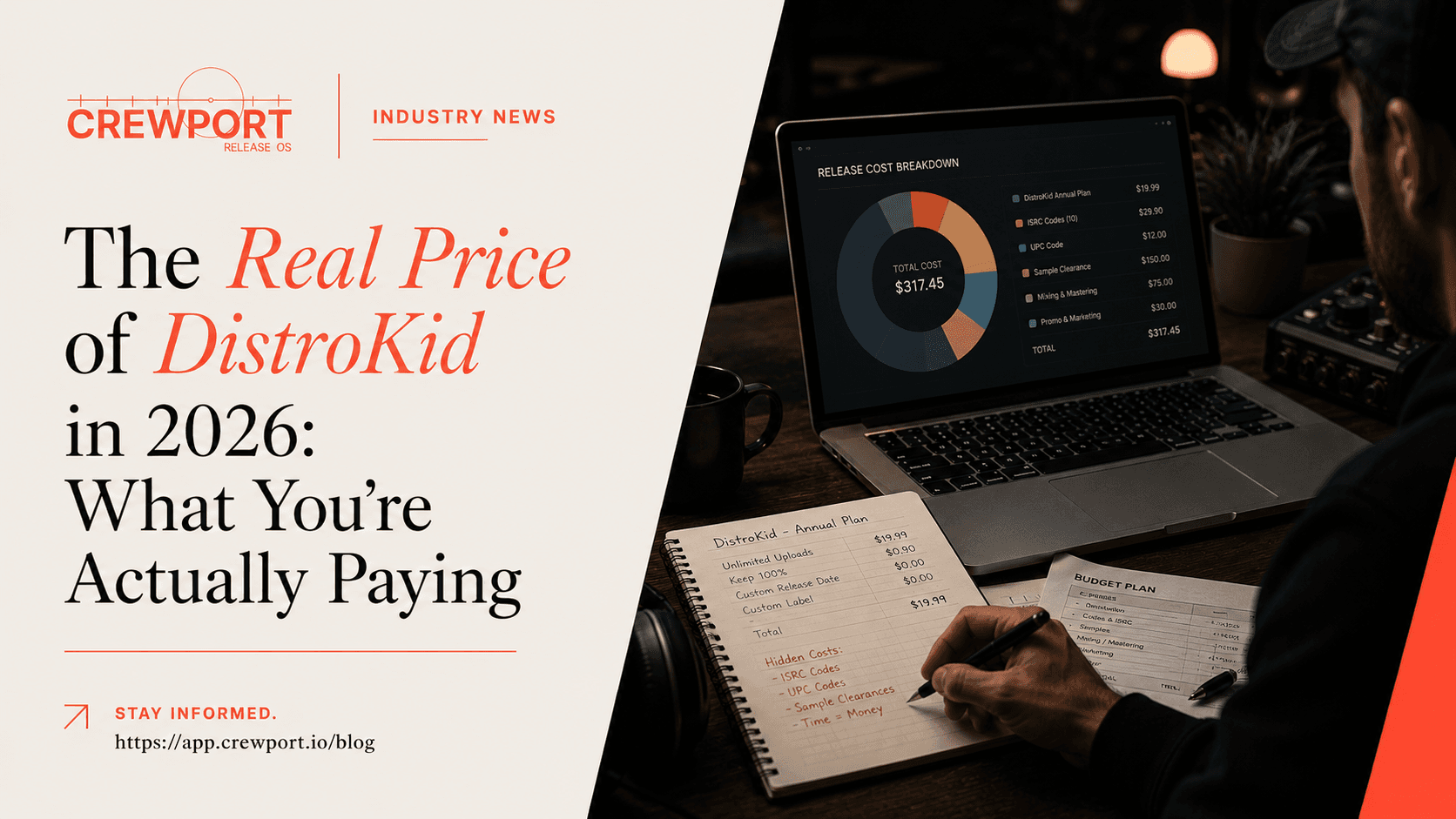
The Real Price of DistroKid in 2026: What You're Actually Paying
DistroKid's pitch is one of the cleanest in music distribution: $22.99 a year, unlimited uploads, keep 100% of your royalties. For an artist releasing a steady stream of music, the per-release math looks unbeatable — and for over a decade, that pitch is exactly why DistroKid ate the market.
But $22.99 is the headline, not the invoice. By the time you've added the features most working artists actually need — and the one feature that decides whether your music survives a missed payment — the real number lands somewhere between $75 and $1,000 a year, depending on how much you release. Here's where every dollar goes, with a calculator at the end so you can run your own situation.
What $22.99 actually buys
The entry-level Musician plan does give you unlimited uploads and zero commission on streaming royalties. What it doesn't give you is most of what a real release requires.
On the base tier, you can't set a custom release date. That sounds minor until you realize it means you can't schedule a Friday drop — the day Spotify refreshes its editorial playlists — and you can't run a pre-save campaign tied to a fixed date. You also don't get daily streaming stats, and you're capped at a single artist name. For anyone treating music as more than a hobby, the base tier isn't really the product. It's the teaser.
The plan most working artists actually land on is Musician Plus, which DistroKid raised to roughly $39.99 a year in 2026. It unlocks custom release dates, pre-orders, daily stats, and a second artist name. Ultimate, at around $49.99, adds advanced analytics and support for up to 100 artist names — the tier built for labels and multi-project artists.
So the real floor for a serious solo artist isn't $22.99. It's about $40. And we haven't touched the add-ons yet.
The add-on that isn't optional: Leave a Legacy
This is the one most artists don't understand until it's too late.
DistroKid's subscription is what keeps your music live. Stop paying — cancel, or simply miss a renewal — and your releases get pulled from every platform, typically within a few weeks. Your streams, your saves, your playlist placements, and your algorithmic momentum all vanish. The Spotify links you've been promoting break.
The only way to prevent that is a feature called Leave a Legacy: a one-time fee of $29 per single or $49 per album that keeps that specific release live permanently, even if you cancel. There's no bulk option and no account-wide version. You buy it release by release.
Do the math on a catalog. An artist with ten singles and two albums pays around $388 in Leave a Legacy fees alone — on top of every annual subscription — just to guarantee their existing music doesn't disappear. For a prolific producer, that number runs into four figures fast.
This is the part of the model worth sitting with. On most distributors, your catalog staying online is the baseline. On DistroKid, permanence is a per-release upsell. Your back catalog is, in effect, held to your subscription — and re-secured one payment at a time.
YouTube Content ID: the 20% that never ends
If you want DistroKid to register your tracks in YouTube's Content ID system — so you collect revenue when other people use your audio — that's $4.95 per song, per year. For a ten-track album, that's roughly $49.50 annually.
But the recurring fee isn't the real cost. DistroKid also takes 20% of the advertising revenue Content ID generates, for as long as you use it. So the one place where the "100% royalties" promise quietly stops applying is the exact feature artists rely on to monetize YouTube. It's a commission — just on a different revenue stream, and one that compounds the more your music gets used.
The fees nobody mentions until payout day
DistroKid pays out through a third-party processor, and the withdrawal fees are easy to miss until you actually try to take your money home.
The minimum payout threshold sits around $6. A standard US ACH transfer runs about $1.12, a paper check $3.37, a SEPA transfer $5.62. Wires are where it stings: roughly $16.85 for a US wire and over $29 for an international USD wire. PayPal adds 2% on top of a flat fee, capped at around $23.59 for non-US residents. None of this is hidden exactly — but none of it is in the $22.99 headline either.
And if you're an international artist who hasn't correctly filed a W-8BEN treaty claim, the IRS withholds 30% of your earnings automatically. That's not a DistroKid fee, but it's a 30% haircut that the platform's frictionless onboarding doesn't go out of its way to prevent.
The calculator: three real artists
Numbers in the abstract don't land. So here's what the real annual cost looks like for three common profiles, all wanting their catalog to survive a cancellation.
The casual artist — two singles a year, Musician plan, catalog protection.
$22.99 subscription + $58 Leave a Legacy = $80.99 in year one. The advertised price was $22.99.
The serious independent — one ten-track album plus three singles a year, Musician Plus, Content ID, catalog protection.
$39.99 subscription + $49 (album) + $87 (three singles) Leave a Legacy + $64.35 Content ID = $240.34 in year one — plus 20% of any YouTube ad revenue, ongoing.
The prolific producer — 24 singles a year, Musician Plus, catalog protection, Content ID, Store Maximizer.
$39.99 + $696 Leave a Legacy + $118.80 Content ID + $190.80 Store Maximizer = roughly $1,045 in year one — plus the 20% YouTube cut.
For the producer who chose DistroKid specifically because $22.99 sounded unbeatable, the real first-year number is over forty times the advertised price.
(Run your own numbers with the interactive calculator below.)
Why the model works this way
None of this makes DistroKid a scam. The base service is fast, the unlimited-upload model is genuinely efficient for high-volume artists, and millions of releases move through it without incident. The pricing isn't deceptive so much as it's unbundled — the cheap headline number is real, and so is everything stripped out of it.
But unbundling has a psychological function. A low entry price gets you in the door and anchors your sense of what distribution "should" cost. The add-ons then arrive one at a time, each individually reasonable — $29 here, $4.95 there — until the total quietly triples. The most expensive of them, Leave a Legacy, is priced against fear: the fear of losing everything you've built if you ever stop paying.
What transparent pricing looks like
This is where we'll be direct, because we built CREWPORT in deliberate opposition to this model.
One price, everything included. Your catalog stays live as a baseline, not a per-release upsell — there is no "pay us again or your music disappears" mechanic. We don't take a commission on any revenue stream, including the ones DistroKid carves 20% out of. And the price you see when you sign up is the price you pay, because there is no menu of extras waiting on the other side of checkout.
That's not a feature list. It's a different philosophy about who the pricing is designed to serve. A model built on add-ons makes the most money from the artists who understand it the least. A model built on one honest price makes the same money from everyone — and doesn't depend on you forgetting to read the fine print.
If the real cost of "unlimited for $22.99" surprised you, that's worth knowing before your next renewal. See how CREWPORT prices distribution — all of it, in one number — at crewport.io.