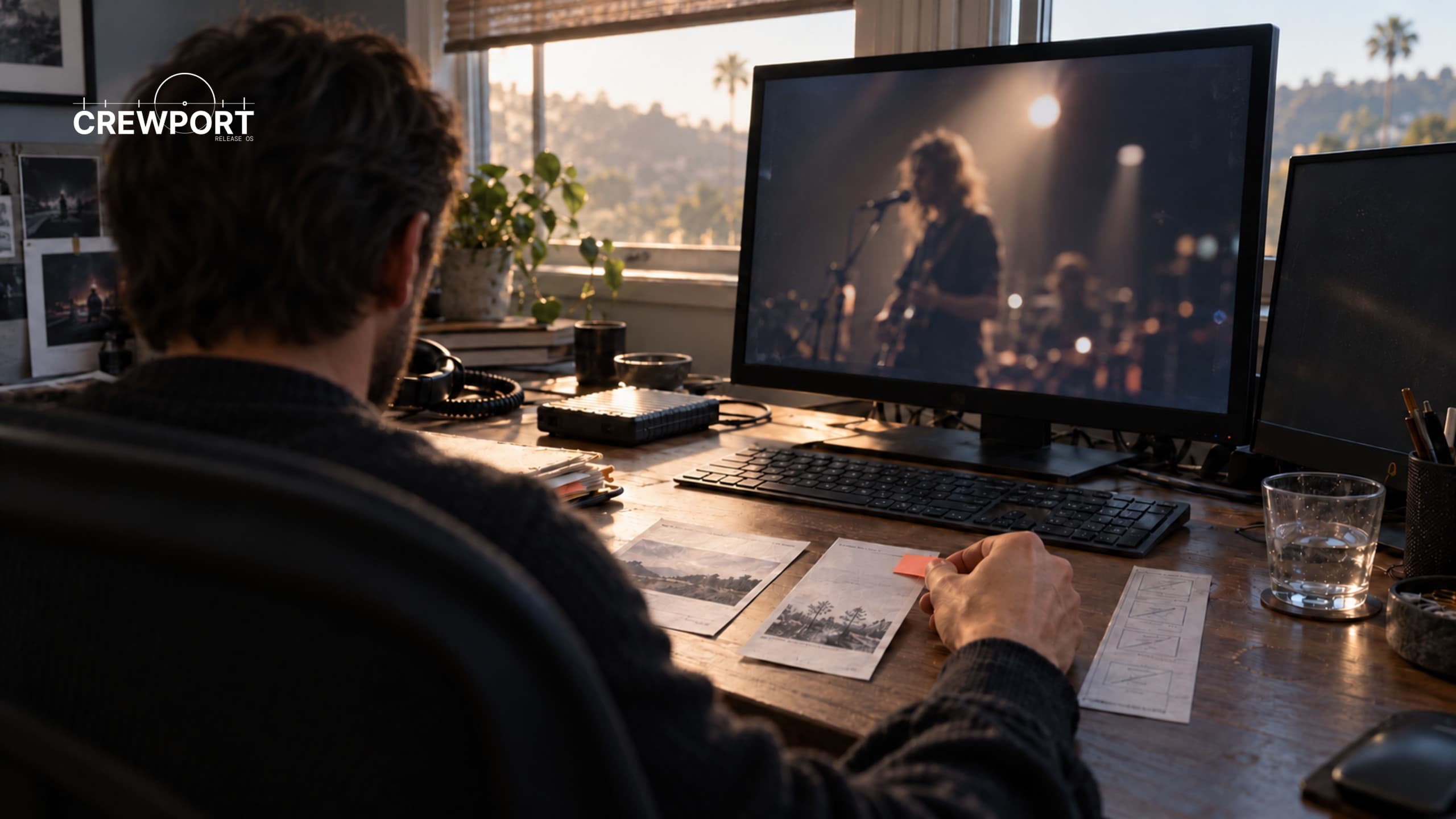
The single went out three weeks early. The Spotify pitch was in on time, written properly, with the campaign dates attached. The video premiered on release morning and the posts went up on schedule.
Nobody pitched the video.
Not out of laziness — it genuinely didn't occur to anyone that it was a separate thing, because for years it wasn't. The video was something you put on YouTube and linked from the caption.
That's changed. Spotify now lets eligible teams submit official music videos and performances for editorial video consideration, and the system around it has grown well past a decorative tab. The operating rule underneath it is short and easy to miss: song and video pitches are separate. Pitching the track does not put the video in front of anybody.
A team that treats the video as an accessory can lose the window entirely. It needs a parallel lane — its own delivery owner, rights check, deadline, pitch and measurement.
Two assets, two decisions
Spotify's guidance is explicit that song and video pitches are separate submissions, and that you can do both for maximum consideration. The forms ask different things: the song pitch is about the recording and the campaign, the video pitch asks about story, genre, mood, visual style and your marketing plans. Either one can be considered without the other.
Neither guarantees anything. A completed form proves only that eligible material reached the consideration process, which is worth saying out loud before somebody builds a forecast on it.
On the release plan, split these into separate lines with separate owners: audio delivery, song pitch, video delivery, video clearance, video pitch, reporting. One person can own all six. What you're protecting against is a ticked audio-pitch box quietly standing in for a video workflow nobody started.
Confirm the delivery route before you commission the edit
Label and distributor delivery remains Spotify's primary path for music video content. On top of that, eligible artists can upload full-length videos directly through Spotify for Artists — on desktop, under Video & Visuals, by an Admin or Editor on the artist or label team.
Direct upload is not available to everyone. It's open to eligible artists in selected countries across six regions — Africa, Asia, Europe, North America, Oceania and South America — and the videos are viewable by Premium listeners in those same countries. Label- or distributor-delivered videos can reach more markets than that.
So before anyone books an edit suite for a Spotify-specific cut, four questions:
- Does the artist account currently show Upload Video under Video & Visuals?
- If not, will the label, distributor or licensor deliver it?
- Which territories and subscription tiers does that delivery actually reach?
- Who handles corrections, takedowns and reporting afterwards?
A distributor that handles your audio doesn't automatically accept music videos on the same plan. The fees, technical requirements and rights review can all be different, and finding that out in release week is an expensive way to learn it.
Spotify for Artists itself is free. The real costs are production, editing, clearance, staff hours and whatever a delivery partner charges. Book those at the asset level rather than folding them into the audio campaign budget, or the video will keep looking free in reporting and keep not being free in practice.
Build to the format Spotify actually takes
For direct uploads, Spotify's content policy accepts live performances, acoustic or studio sessions, covers, and alternate versions such as dance videos.
It explicitly does not accept visualizers or lyric videos, videos without music, or videos containing more than one song — a full concert has to be split into one video per song. Performance videos should contain a single song with the music as the clear focus.
One thing worth checking yourself before you plan around it: Spotify's upload page lists official music videos among the content you can upload, while the content policy page says to deliver official music videos through your label or distributor. Those two pages don't read the same way. If an official video is your asset, confirm the current route with your distributor or partner manager rather than assuming either page is the final word.
Technical requirements for direct upload: landscape 16:9, at least 1920 × 1080, longer than 30 seconds, shorter than 20 minutes, under 50 GB. MP4 is recommended; MOV and MPEG-4 are also compatible.
A vertical social edit is not a substitute for the full-length landscape master. A static-image visualizer doesn't qualify just because it performs fine on another platform.
Keep a video delivery record alongside the audio one:
- final file name, duration, resolution, checksum
- linked song and audio ISRC
- video title, type, version, original release date
- video ISRC, where one has been assigned
- thumbnail choice
- explicit and 18+ status
- songwriter and publisher information
- territorial restrictions
- production, performer, location, artwork and third-party licences
CREWPORT's guided release workflow keeps the audio identifiers, contributors, assets and delivery dates attached to one release record, so the video lane isn't being tracked in somebody's notes app. Spotify eligibility and video permissions still have to be verified by the team and the rights partners — we can't grant upload access or confirm a publishing opt-in on anyone's behalf.
Clear more than the master
The composition, the performers, the director, the production agreements, archival footage, locations, trademarks, artwork, any licensed visual material. Covers deserve particular attention, because permission to distribute an audio cover doesn't automatically settle every audiovisual use of the same song.
Then there's a US-specific requirement that catches a lot of teams, and it sits outside the delivery chain entirely.
Spotify uses songwriter and publisher ownership data registered with The MLC to determine whether a music video can stream in the US — separately from whatever your label or distributor delivered. Every songwriter on the underlying work has to be a member of The MLC, have the work registered there, and opt in to Spotify's Direct Audiovisual Licensing Agreement, which is hosted and maintained by the Harry Fox Agency. Once all of that is complete, Spotify says the video can take up to seven days to become available for streaming in the US.
Read that timeline next to the seven-day pitch window and the problem becomes obvious. Those two clocks can run out at the same time if nobody started early.
A caution on how to handle it: this is not a reason for an artist to go around an exclusive publisher. Where there's a publishing agreement, the publisher is normally the one registering works with the MLC and HFA and making the licensing decision. Ask the administrator to confirm completion. Creating a competing registration to move faster creates a dispute, not a release.
If a territory ends up blocked, treat it as a rights incident rather than a marketing annoyance. Keep the notice, work out who the claimant is, and use the appeal only when you can actually demonstrate the authority you're claiming.
Protect the seven-day window
An eligible video can be pitched while it's unreleased, or within seven days of release.
The counting differs by route. For a label- or distributor-delivered video, Spotify counts from the release date. For a direct upload, it counts from the upload date.
Which cuts both ways. Upload too early and you burn part of your own window before the campaign starts. Wait until release morning and you've left nothing for a rejected file, a permissions problem or a processing delay.
And there is processing. After a successful upload Spotify says the video can take up to 24 hours to appear, with video analytics arriving roughly 24 hours after it goes live. Build the buffer in, and check the status before any post points listeners at it.
A sequence that works:
- Confirm upload or partner-delivery access before the video is commissioned.
- Finish clearance and metadata before the final export.
- Deliver on the partner's timetable, or schedule the direct upload with processing time to spare.
- Verify the asset appears under Video & Visuals and that the right people have Admin or Editor access.
- Submit the video pitch while it's still eligible.
- Check the live asset: territories, thumbnail, linked song, audience labels.
On permissions, because this is the one that bites on launch day: for partner-delivered videos you need Admin or Editor access on the artist team, or a label team with rights to the release. For direct uploads, the pitcher needs Admin or Editor on the team that uploaded it — and only that team can pitch it. Sort this out in advance, not at 9am on a Friday while someone's trying to find out who still has the old manager's login.
Write a video pitch, not a recycled song pitch
The editor already has the recording. What they don't have is a reason to think the moving image is worth watching.
Useful: the performance setting, the narrative idea, the visual language, who made it, what the audience activity around it looks like. Mention a premiere, tour moment or partner activation only if it's confirmed — an editor who follows up on an unconfirmed claim will remember.
Less useful: superlatives and predictions. "Cinematic" tells nobody anything without the actual visual idea attached. A promised view count says nothing about editorial suitability.
And the pitch has to match the file. If the form describes a continuous live take and the upload is a narrative edit, the copywriting is the smaller of your two problems.
Measure it as its own asset
Spotify counts a stream after at least 30 seconds of playback, the same threshold that applies to audio. Spotify for Artists reports all-time video streams along with stream and listener trends, and that data generally shows up about a day after publication.
Keep three layers apart in the report:
Availability — did it process, which territories are live, is it linked to the right song, are there unresolved blocks.
Consumption — video listeners, video streams, repeat viewing over a defined period.
After-effects — subsequent audio listening, saves, playlist adds, deeper catalog activity, where the reporting actually supports the observation.
Spotify has published company-wide analysis on that last layer: compared with fans who only streamed the audio, listeners who watched a video streamed that song 64% more often over the next three weeks, were 1.4× more likely to save, share or add it to a playlist, and streamed 57% more of the rest of the artist's catalog in the same period.
Those are aggregate associations from Spotify's own data. They're a decent argument for making the asset. They are not a forecast for your release and not a causal estimate — the people who choose to watch a video are already a different group from the people who don't.
For your own report, compare the launch against a documented baseline and log every simultaneous intervention. Spotify's Source of Streams can separate active from programmed listening across audio and video, which helps. A change after release still doesn't prove the video caused it.
One thing not to do: calculate a universal per-stream payment for video. Full-length videos can be royalty-bearing and can be chart-eligible — Spotify runs a global music video chart ranking the top 50 by daily stream count — but what actually reaches an artist depends on the rights, the eligible activity and the contract with the label or distributor.
A hypothetical two-video test
A small label, two singles from the same artist, both with finished performance videos and comparable release support.
On the first, they upload on release day. The US publishing opt-in turns out to be incomplete, which nobody discovers until the video isn't streaming in the artist's biggest market. Several days of troubleshooting later the pitch goes in, by which point the strongest campaign moment has gone.
On the second, delivery access is confirmed four weeks out, the publisher confirms the registrations, the landscape master is validated against spec, and the upload is scheduled with processing time in hand. The pitch describes the one-take studio performance and the session content supporting it.
If the second performs better, that supports improving the workflow. It doesn't prove the pitch caused the difference — different songs, different videos, different audiences.
But the operational finding is the useful one: the second video launched without preventable rights or access delays, and the team can prove it.
Who should wait
Don't force this when:
- there's no direct-upload access and no partner who'll deliver video
- the asset is a visualizer, a lyric video or a multi-song concert
- publishing or audiovisual rights are unresolved
- nobody can confirm which recording the video should link to
- a territorial licence conflicts with the intended availability
- the file can't meet the basic technical spec
- nobody holds the permissions needed to pitch or manage it
- the cost displaces higher-priority work with no defined objective
A video isn't automatically a sensible investment because the platform now supports the format. An artist with limited production budget will usually get more out of one defensible performance asset than three rushed ones.
FAQ
Does pitching my song also pitch the video?
No. Spotify states that song and video pitches are separate. You can submit both.
How long do I have to pitch a video?
While it's unreleased, or within seven days of release — counted from the release date for partner-delivered videos, and from the upload date for direct uploads.
Can I upload a video myself?
Only if your account is eligible and you're in one of the supported countries, with Admin or Editor access. Label and distributor delivery remains the primary route.
Who can see a directly uploaded video?
Premium listeners in the supported countries. Partner-delivered videos may be available more widely.
Can I upload a visualizer or a lyric video?
No. The content policy excludes visualizers, lyric videos, videos without music, and videos containing more than one song.
What are the file requirements?
Landscape 16:9, at least 1920 × 1080, over 30 seconds, under 20 minutes, under 50 GB. MP4 recommended; MOV and MPEG-4 compatible.
Why isn't my video streaming in the US?
Most often the publishing side. Every songwriter needs MLC membership, the work registered, and an opt-in to Spotify's Direct Audiovisual Licensing Agreement via HFA — then up to seven days for US enablement.
How fast does it go live?
After successful processing, up to 24 hours to appear, and video analytics around 24 hours after that.
Does a video stream pay the same as an audio stream?
There's no universal rate to quote. Videos can be royalty-bearing, but what reaches the artist depends on rights and contracts.
Give the video its own lane
Spotify's video surface now reaches a lot further than a tab on the profile — personalized video playlists, the artist profile video tab, Home, release pages, Now Playing, editorial video playlists and fan notifications.
That reach arrives with conditions attached. The file has to be supported. The rights have to clear, including a US publishing step that has nothing to do with your distributor. The right people need access. And the pitch has to land inside a window that starts counting from a date depending on how the video got there.
Pitch the song because it's a song. Pitch the video because it gives someone a reason to watch.
Then manage both as release assets whose status you can prove after the campaign is over, which is usually when somebody finally asks.
CREWPORT keeps identifiers, contributors, assets and delivery dates attached to one release record, so the video lane has the same paper trail as the audio. Upload eligibility, publishing opt-ins and editorial outcomes stay with Spotify and your rights partners.
Note: general operational guidance, not legal advice. Direct video upload and video pitching are rolling out gradually — eligibility, supported countries and partner-delivery terms differ by artist and by distributor, and Spotify can revise its specifications and policies. Spotify's published engagement figures are aggregate company analysis rather than causal estimates or forecasts for any individual release. Spotify's upload and content-policy pages currently describe the route for official music videos differently; confirm with your partner. Verify current requirements in Spotify for Artists before building a process on any detail here.
Sources
- Spotify for Artists — Pitching music and videos to playlist editors
- Spotify for Artists — Uploading videos in Spotify for Artists
- Spotify for Artists — Content policy for uploading videos
- Spotify for Artists — Music video publishing rights and clearances
- Spotify for Artists — How video on Spotify takes your fans further
- Spotify for Artists — Source of streams