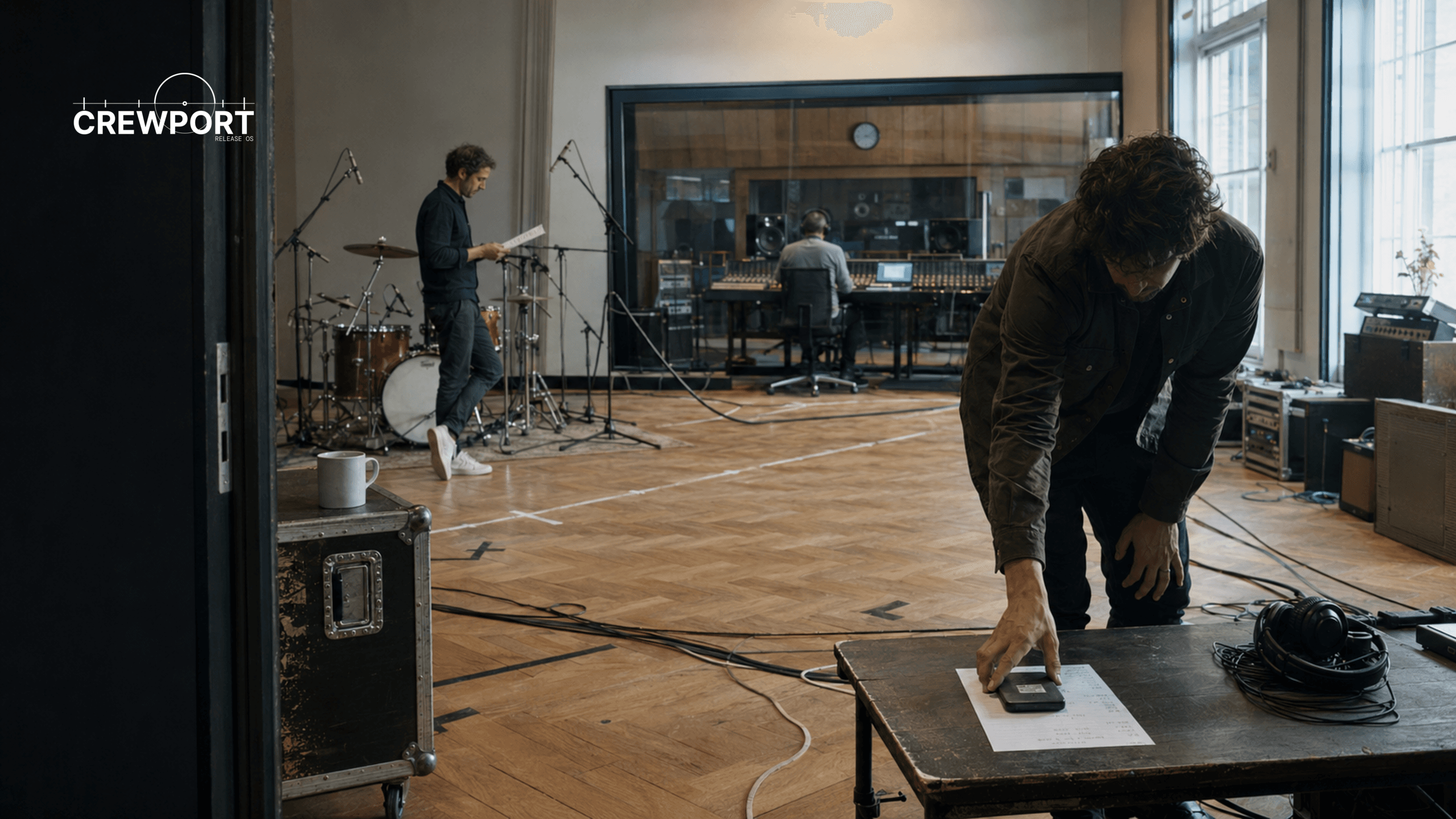
Peter Gabriel's Real World Studios is offering several unsigned artists something emerging acts rarely get: multiple days in a world-class facility, with professional engineers, mixing, mastering and industry mentoring.
The new amplified@rw program will select four to six artists from South West England, with applications closing September 9, 2026. Real World is deliberately accepting rough material — phone recordings, bedroom demos — because it wants to hear the idea rather than the applicant's production budget.
That's the right standard for choosing talent. It is not how an artist should arrive for the actual recording session.
Once a project is selected and the dates are fixed, charming disorder becomes expensive. The drummer doesn't know which arrangement is final. The singer wants to rewrite the second verse. A software instrument won't open on the studio computer. Somebody has the latest backing vocals — on a laptop at home.
Meanwhile the room, the engineer and the musicians are all on the clock.
A professional studio gives the music better conditions. Preparation decides how much of those conditions actually reaches the recording.
Decide what the session is supposed to produce
"Record the song" is not a session objective.
Before booking, define what must exist when the session ends: final drums and bass for four songs; one complete live-band performance; lead vocals and harmonies for a single; acoustic overdubs; a finished stereo mix; consolidated multitracks for an outside mixing engineer; an alternate performance for video; material for an immersive mix.
Those are genuinely different jobs. A band recording live needs time for mic placement, monitoring and complete performances. A vocalist working over a finished production needs an approved instrumental, a lyric sheet, and a plan for leads, doubles, harmonies and extra parts. A session meant to end in a final mix has to leave room for editing and revisions after the recording is done.
Ask the studio or engineer for a realistic schedule. Then decide, in advance, what gets cut if the day runs late — that decision is much easier at home than at 11:40 p.m. with everyone exhausted.
Finish pre-production before the clock starts
Pre-production is where you find out whether the song is actually ready to record. Confirm: structure, key, tempo and tempo changes, time signatures, count-ins, transitions, solos, endings, lyric, harmony parts, instrumentation, reference sound.
Then record a rehearsal or working demo and listen to it away from the practice room. A structural problem that's invisible while you're playing can be brutally obvious on playback.
Avid's production guidance frames pre-production as the stage for defining the project, examining demos, identifying incomplete songs and estimating time and personnel — with scheduling and organization handled before recording, so the session can concentrate on music.
Not everything has to be frozen. Some of the best studio moments come from discovery. The team just needs to know which decisions are intentionally open and which were quietly avoided.
"Let's try two guitar sounds" is a plan. "We haven't discussed the guitar" is a delay.
Make a one-page session brief
The producer, engineer and musicians should all have one current document with: artist and project name; session date and location; contact details; songs being recorded; key, tempo and time signature per song; arrangement notes; instrument and vocal requirements; expected deliverables; technical references; schedule and breaks; the named decision-maker; and any known rights or clearance issues.
Add links to the latest demos and references — and don't attach five mixes called "final," "new final" and "final actual." Use version numbers and dates:
Artist_Song_Demo_v06_2026-08-18.wav
Boring filenames prevent remarkably dramatic phone calls.
Prepare the session files for someone else's computer
A project that opens perfectly in your bedroom may fail in another studio. Different DAW, operating system, plug-in version or sample library. A virtual instrument authorized only on the producer's machine. A vocal effect depending on a preset nobody exported.
Before the session:
- Remove unused tracks and obviously failed takes.
- Name every track clearly.
- Confirm sample rate, bit depth and frame rate where video is involved.
- Export or print essential software instruments.
- Render crucial effects if the receiving studio may not have the plug-ins.
- Keep dry versions where later processing choices may change.
- Export audio from a common start point so every file stays aligned.
- Include the tempo map and time-signature changes.
- Supply the latest rough mix.
- Write a track list explaining anything unusual.
- Test the exported files in a new, empty project.
- Copy the package to two separate storage locations.
One distinction worth getting right: don't send only stems if the engineer asked for multitracks. A stem is a combined group — all drums, all backing vocals. A multitrack package normally contains the individual recorded elements. Both are useful; they give very different levels of control. If there's any doubt, ask for delivery specs before you export.
Rehearse the version you're actually recording
Knowing the song is different from knowing the version being recorded. Musicians should practise to the chosen tempo or tempo map, with the agreed count-in, using the final structure, with the correct transitions and ending, in the key intended for the singer, with any backing tracks or programmed elements, at the dynamic level expected in the studio.
If the tempo is still under discussion, test several options in rehearsal and record them. Three BPM can change the singer's phrasing, the drummer's pocket and the emotional weight of a chorus.
Session musicians should get the song, chart and production references early enough to prepare. Berklee describes reliability, organization, flexibility and the ability to follow direction as central professional skills for session players, alongside reading charts or other clear musical instructions. Hiring an excellent player and then withholding the material until they arrive wastes exactly the skill you're paying for.
Protect the vocal before the session
A vocal session depends on a physical instrument you can't swap for a spare from the equipment cupboard.
Before recording: sleep properly; rehearse without exhausting the voice; bring water; avoid experimenting with unfamiliar remedies; print or display the final lyric clearly; mark breaths, harmonies and alternate lines; identify difficult passages; decide whether the singer wants a lower or higher monitoring level; and schedule demanding lead vocals before fatigue sets in.
The singer should also practise with headphones. Plenty of performers change pitch, timing or volume the first time they hear their own recorded voice up close. Berklee's vocal-session guidance recommends getting familiar with the sound of your recorded voice and practising recording technique before entering a professional studio.
Don't spend the first paid hour discovering that the headphone mix makes the singer pull one side off and shout.
Clear the people and the rights
Recording creates a business record as well as an audio file. Before the session, confirm in writing: who's paying; the producer's fee and royalty; session-musician rates; overtime and cancellation terms; travel or equipment expenses; whether the work is union-covered; who owns the recording; whether contributions are work made for hire or licensed; performer consents; songwriter shares; sample and beat licences; permission for any existing audio being reused; credit language; delivery obligations.
Don't wait until release week to find out whether the guitarist expected a master royalty.
A split sheet should follow the songwriting session while everyone still remembers who changed the hook — but it isn't a substitute for a proper producer, performer or master-ownership agreement.
Keep it proportionate. A simple session may need only a short written agreement and an accurate invoice. A label project with advances, featured performers, samples and continuing royalties needs more. Either way, the studio is not responsible for inventing the chain of title after the recording is finished.
Assign one person to make final decisions
Creative discussion is useful right up until six people start giving the engineer different instructions.
Name one producer, artist or project lead who can approve takes, arrangement changes, sound choices, additional recording time, editing priorities and final deliverables. Everyone else still contributes — the engineer simply needs to know whose decision closes the discussion.
This matters most when the artist, manager and label rep are all in the room: one is thinking about performance, one about budget, one about the single's market position. Without a final authority, the control room becomes a meeting with a microphone in it.
Build the day around what needs the room
Use professional studio time for work that benefits from a professional studio: live ensemble recording, drums, acoustic instruments, amplifiers, grand piano or specialist gear, performances needing visual communication, critical vocals, microphone comparisons, room sound.
Administrative editing, lyric rewrites, file exports and hunting for references can happen almost anywhere else.
A sensible sequence: load-in and technical setup → soundcheck and headphone mixes → a complete rehearsal take → core performances → repairs and alternate takes → essential overdubs → playback and take selection → file consolidation and backups → rough mix and written handoff notes.
Don't leave file copying until everyone's standing by the door. Large sessions take real time to verify.
Keep a take sheet
After nine vocal takes and six guitar passes, memory becomes unreliable. Log the take number; whether it's complete or partial; the strongest sections; technical problems; tuning or timing notes; alternate lyrics; the producer's preferred take; sections needing repair.
Paper, spreadsheet or inside the project — it doesn't matter, as long as somebody maintains it consistently.
"Take four felt best" is useful. "The good one was somewhere before dinner" is not.
Leave with more than a stereo bounce
Before the session ends, confirm what the studio keeps and what the artist receives. Depending on the project, that handoff might include the complete session folder; consolidated individual tracks; dry and processed vocals; MIDI and tempo map; comped performances; alternate takes; rough stereo mix; instrumental; clean version; lyric sheet; track and take notes; a list of equipment or unusual processing; credits; sample rate and bit depth; and backup confirmation.
Clarify whether the engineer keeps a copy, for how long, and what it would cost to restore the project later. Then maintain at least two verified backups yourself. A studio archive is a convenience — not your permanent catalog-management system.
Capture the credits while everyone is still in the room
Write down the full professional names and roles of every contributor before they vanish into other projects: producer; recording engineer; assistant engineer; performers and instruments; vocal producer; programmer; arranger; songwriter and composer information; studio; recording dates; mixing and mastering responsibilities.
These details later feed distributor metadata, liner notes, rights registrations, neighboring-rights claims and royalty administration. Artists preparing a release through CREWPORT can use its guided metadata workflow to submit producer, performer and songwriter information — but the easiest time to collect it is still the session itself, not six months later by group chat.
A hypothetical two-day session
A band books two days for three songs. It arrives with rehearsed arrangements, tempo maps, labelled backing tracks, signed musician agreements and one-page briefs. The engineer imports the files the evening before. By the first morning, the band is playing a complete take within an hour.
Now change one thing at a time. The keyboard parts exist only inside an incompatible plug-in. Two songs have different tempo versions floating around. The bassist rehearsed an earlier structure. The singer rewrites the bridge after lunch. And nobody has discussed whether the guest guitarist gets a royalty.
The studio hasn't become less professional. Its professional resources are just being spent solving preventable problems. The difference between those two sessions might be an entire finished song.
The final checklist
Before you leave for the studio, confirm:
- the purpose and deliverables are defined;
- songs, keys, tempos and arrangements are ready;
- musicians have rehearsed the correct versions;
- lyrics and charts are current;
- session files open and exported audio aligns correctly;
- plug-in-dependent parts have been rendered;
- the studio has demos, references and technical notes;
- instruments and equipment have been checked;
- fees, overtime and cancellation rules are understood;
- ownership, credits and contributor terms are documented;
- one person has final approval authority;
- storage drives and backups are ready;
- the day includes time for playback and file verification.
Real World is right to accept rough demos from applicants — a polished production shouldn't be the price of entry to a development opportunity. But once the door opens, the standard changes.
The studio should be where the music becomes larger, sharper and more alive. Not where the team finally decides which version of the song it came to record.
FAQ
How early should I start preparing for a studio session?
Pre-production should be finished before the booking, not during it. Arrangements, keys, tempos, lyrics and file exports need enough lead time that session musicians and the engineer receive material days ahead — not on the morning.
What files should I send the studio beforehand?
Ask the engineer for delivery specs first. Generally: labelled multitracks exported from a common start point, the tempo map and time-signature changes, rendered versions of any plug-in-dependent parts, the latest rough mix, and a track list explaining anything unusual. Test the export in a new empty project before you send it.
What's the difference between stems and multitracks?
A stem is a combined group — all drums, all backing vocals. A multitrack package contains the individual recorded elements. They offer different levels of control, so don't substitute one for the other without asking.
Who should have final say during the session?
One named person — producer, artist or project lead — who can approve takes, arrangement changes, sound choices, extra time and deliverables. Everyone can contribute; the engineer needs to know whose word ends the discussion.
What should I leave the studio with?
More than a stereo bounce: the session folder, consolidated tracks, dry and processed vocals, MIDI and tempo map, alternate takes, rough mix, take notes, credits, and the sample rate and bit depth — plus two verified backups of your own.
When should I collect credits and splits?
At the session. Full professional names, roles and songwriter shares while everyone is present and remembers who changed what. Chasing that information months later is how credits end up wrong on release.
The session ends. The metadata is forever.
Everything you capture in the room — producer, engineer, performers, songwriter shares, recording dates — becomes the data your release depends on. Wrong or missing, it breaks credits, registrations and royalty matching for years.
CREWPORT gives you a guided metadata workflow with validation before delivery, so the credits you collected at the session arrive intact and your recording is identified correctly from day one.
Note: program details and deadlines can change — confirm current eligibility and dates on the studio's official page before applying. Contributor agreements and ownership terms vary by project; get qualified legal advice for anything involving advances, samples or continuing royalties.
Sources
- Real World Studios — amplified@rw Program
- Crack Magazine — Real World Studios Launches Free Recording Program, August 19, 2026
- Real World Studios — The Big Room and Current Recording Facilities
- Avid — Pre-Session File Management and Production Planning
- Berklee Online — Preparing for a Vocal Recording Session
- Berklee — Professional Expectations for Session Musicians