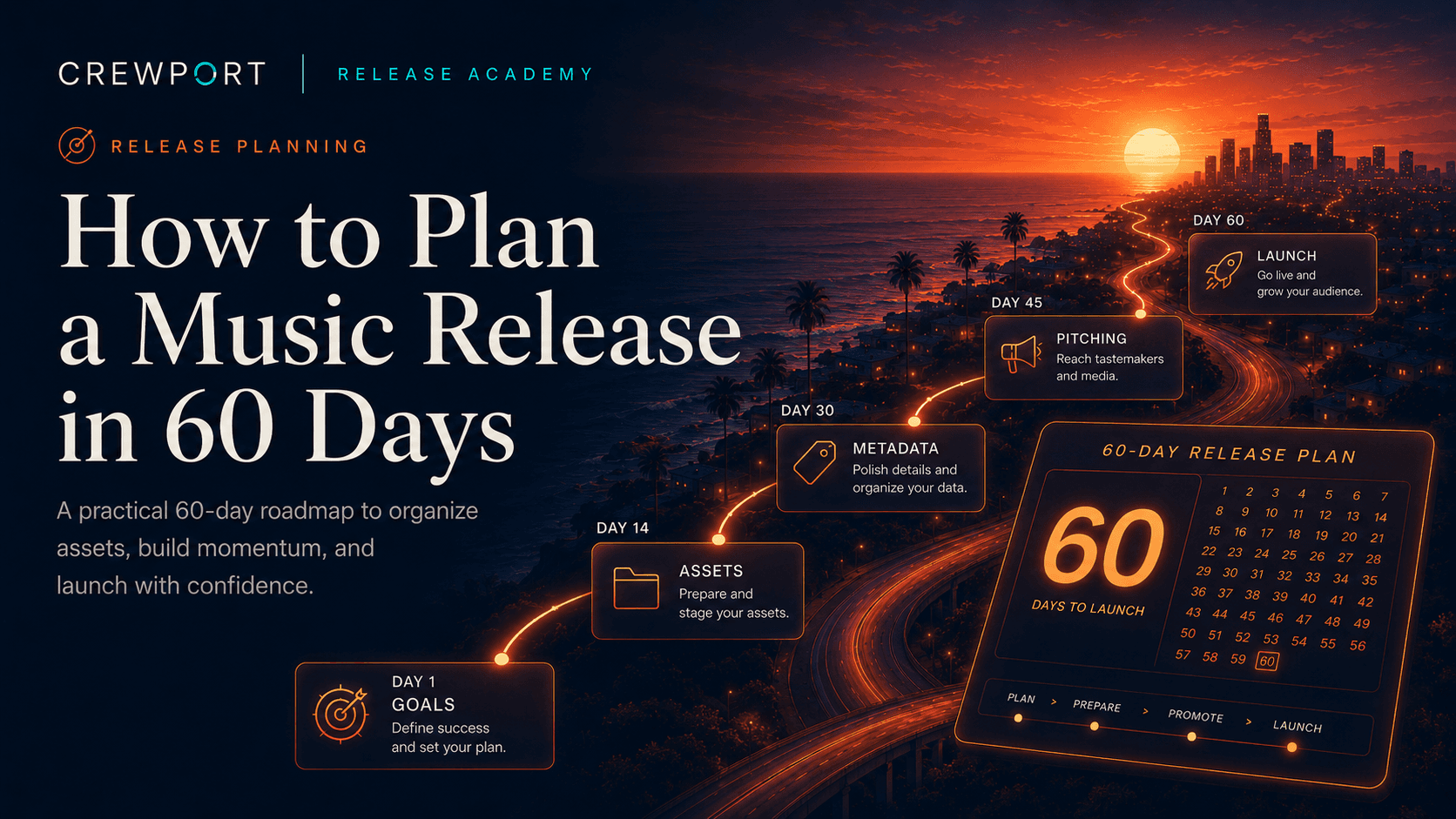
Sixty days is the right amount of time for a professional independent release.
It's enough to pitch Spotify editorial, build a real pre-save campaign, do meaningful
press outreach, create content without rushing, and still have time to fix problems
if something goes wrong in distribution.
Most artists who struggle with releases aren't struggling because they lack talent
or audience. They're struggling because they compress everything into two or three
weeks and then wonder why the results don't match the effort. A 60-day plan changes
that — not by doing more, but by doing the same things at the right time.
Here's how to use those 60 days well.
Before day one: what needs to be ready
The 60-day clock starts when your assets are finished. Not when you think they're
almost finished. Not when the master is 90% there.
Before day one:
- Finished master — approved, no further changes planned
- Finished cover art — 3000×3000px, RGB, no embedded URLs, handles, or
third-party logos - Complete metadata — track title, artist names in final form, songwriter and
producer credits with full legal names, genre, language, rights confirmation
If the master isn't done, the 60-day plan hasn't started.
Days 1–7: Submit and lock the foundation
Day 1: Submit to distribution
Submit your release on day one with your target release date set 55–58 days out.
This gives you the 7-week editorial window with a few days of buffer for any
distributor processing time.
Immediately after submitting:
- Submit your Spotify editorial pitch through Spotify for Artists — this opens
as soon as your release is in Spotify's system, usually within a few days
of distributor submission - Note the submission confirmation and expected delivery dates from your distributor
- Track store-by-store delivery as platforms confirm receipt
Days 2–7: Set up your infrastructure
- Claim and update your Spotify for Artists and Apple Music for Artists profiles
if not already done — bio, header image, artist pick - Set up your pre-save link as soon as it's available from your distributor
- Build your smart link or release landing page — this will be your single
destination across all promotion - Add the pre-save link to all bio links immediately
Days 8–21: Content foundation and early outreach
With distribution submitted and infrastructure in place, the next two weeks are
about building the content foundation and beginning early outreach.
Content creation
Map out your full content calendar for the next seven weeks. You're not posting
everything now — you're planning and creating assets so you're not scrambling later.
Think in three phases:
- Awareness phase (weeks 2–4): Introduce the release without overexposing it.
Behind-the-scenes content, the story behind the track, production process clips,
mood and aesthetic content that sets the tone. - Anticipation phase (weeks 5–6): Pre-save push, audio teasers, countdown content,
direct calls to action. - Release phase (weeks 7–8): Full push on and around release day, then sustaining
content for two weeks post-release.
Press outreach — first wave
Major music blogs, editorial sites, and publications have lead times of 4–6 weeks
for features and premieres. Week two is when to approach them.
What to send:
- A brief, direct pitch — what the track is, who you are, why it's relevant to
their audience - Your release date
- A private listening link
- A high-resolution press photo and any relevant visual assets
- A short bio — three to five sentences, no more
Keep it concise. Editors receive dozens of pitches daily. A pitch that takes more
than 60 seconds to read is a pitch that often doesn't get read.
Days 22–35: Pre-save campaign and independent playlist outreach
Pre-save campaign
From day 22 onwards, the pre-save call-to-action becomes a consistent part of
every piece of content you post. Not the only thing you post — but present in
every post in some form.
Test different framings:
- Urgency: "Drops in two weeks — save it now so you don't miss it"
- Value: "Save it now and it goes straight to your library the moment it's out"
- Story: "This is the track I've been working toward for two years. Save it."
What works depends on your audience. Start early enough that you have time to
learn what resonates before the release.
Independent playlist outreach
Week four is the right time to begin pitching independent playlist curators.
Most independent curators need 1–2 weeks to review and add a track — which
means pitching now puts you in position for adds around or just after release day.
Research playlists in your genre with active curation and engaged followings.
Pitch individually. Include the genre, mood, tempo, key influences, and why
you think it fits their specific playlist. Generic mass pitches get ignored.
Second wave press outreach
Follow up on any first-wave pitches that haven't responded. Send new pitches
to medium-sized blogs and genre-specific sites that have shorter lead times.
Days 36–49: Intensify and prepare
Content frequency increases
Move from 3–4 posts per week to 5–6. The closer you get to release day, the
more present you need to be in your audience's feed.
Audio teasers, visual snippets, and short-form video content perform particularly
well in this window. Give people enough to want more — not enough to feel like
they've already heard the track.
Confirm delivery status
By day 42 at the latest, confirm your release is delivered and scheduled correctly
on every platform. Check Spotify, Apple Music, TikTok, and Instagram specifically.
If there's a delivery issue on any platform, you have time to resolve it before
release day. A delivery problem discovered on day 58 is a crisis. One discovered
on day 42 is a support ticket.
Prepare release day content in advance
Write captions. Export graphics and video assets. Schedule what can be scheduled.
Plan your release day post sequence — what goes live when, on which platform,
in what order. On release day itself you want to be engaging with your audience,
not producing content.
Email list
If you have an email list, prepare your release announcement email. Send it
two to three days before release day — not on the day itself, when inboxes
are competing with everything else.
Days 50–60: Release week and beyond
2–3 days before release
- Send your email list announcement
- Post a final pre-save reminder
- Confirm one more time that the release is live and scheduled correctly everywhere
Release day
- Verify the track is live on every platform before posting anything
- Push your smart link across all channels simultaneously
- Be present and responsive all day — reply to comments, share reposts,
acknowledge every listener reaction you can - The first 24–48 hours of engagement signal heavily to algorithms
Days 51–60: Post-release sustain
This is the phase most artists skip. Don't.
The algorithm continues evaluating your release for 10–14 days after it goes live.
Every day of continued activity in this window contributes to whether the track
gets pushed further. Keep posting:
- Listener reactions and quotes
- Playlist adds as they come in
- Any press coverage
- Behind-the-scenes or making-of content that didn't fit the pre-release calendar
- Short-form video using the track audio
Check your Spotify for Artists and Apple Music for Artists data from day 3 onwards.
Save rate, skip rate, and listener-to-stream ratio tell you whether the release is
performing the way you expected — and what to adjust in your promotion if it isn't.
The 60-day plan at a glance
- Days 1–7: Submit to distribution; submit Spotify editorial pitch; set up
pre-save and smart link; claim artist profiles - Days 8–21: Content calendar planned; assets in production; first-wave
press outreach sent - Days 22–35: Pre-save campaign active; independent playlist outreach;
second-wave press outreach - Days 36–49: Content frequency increases; delivery confirmed on all platforms;
release day content prepared; email announcement drafted - Days 50–53: Final pre-save push; email list notified; delivery confirmed
- Days 54–60: Release day through post-release sustain; data review;
ongoing content and curator outreach
Common mistakes
- Starting the 60-day plan with an unfinished master and losing the first week
to final revisions - Submitting to distribution but forgetting to separately submit the Spotify
editorial pitch - Treating the pre-save campaign as a single post instead of a sustained effort
- Confirming delivery only on Spotify and missing a problem on TikTok or Instagram
- Going quiet after release day and losing the algorithmic evaluation window
- Pitching press too late — first-wave outreach needs to go out in week two,
not week five
CrewPort workflow tip
At day 42, run a full delivery check across every store before you enter the
final push phase. CrewPort shows you store-by-store delivery status in your
dashboard — so a missing store or a delivery failure surfaces while you still
have time to resolve it, not the night before release day.
FAQ
Is a 60-day plan necessary for every release?
Not for every release — but it's the right default for any release you're actively
promoting. Singles you're releasing purely for catalog building can move faster.
Releases that matter to your career trajectory deserve the full timeline.
What if I miss the Spotify editorial pitch window?
Submit the pitch as early as possible anyway — some editorial teams review late
submissions when volume allows. Focus the rest of your energy on independent
playlist pitching and strong organic content, which influence algorithmic playlists
regardless of editorial consideration.
How many playlists should I pitch?
Quality over quantity. Twenty targeted, individually written pitches to relevant
playlists outperform two hundred generic emails every time. Focus on playlists
where your track genuinely fits — curators can tell when a pitch is specific
versus when it's part of a mass campaign.
Should I release on a Friday?
Friday is the industry standard. New Music Friday editorial playlists on Spotify
and Apple Music update on Fridays. Algorithmic playlists reset on a weekly cycle
that aligns with Friday releases. There's no rule requiring a Friday release, but
there are meaningful structural reasons why it works better.
How do I measure whether my 60-day campaign worked?
Look at save rate, listener-to-stream ratio, and monthly listener growth in the
30 days following release. These metrics reveal whether the campaign built genuine
new audience — not just one-time streams from promotional activity.
Last updated: May 2026
Ready to run a 60-day release campaign with the right tools from day one?
Apply for Early Access →