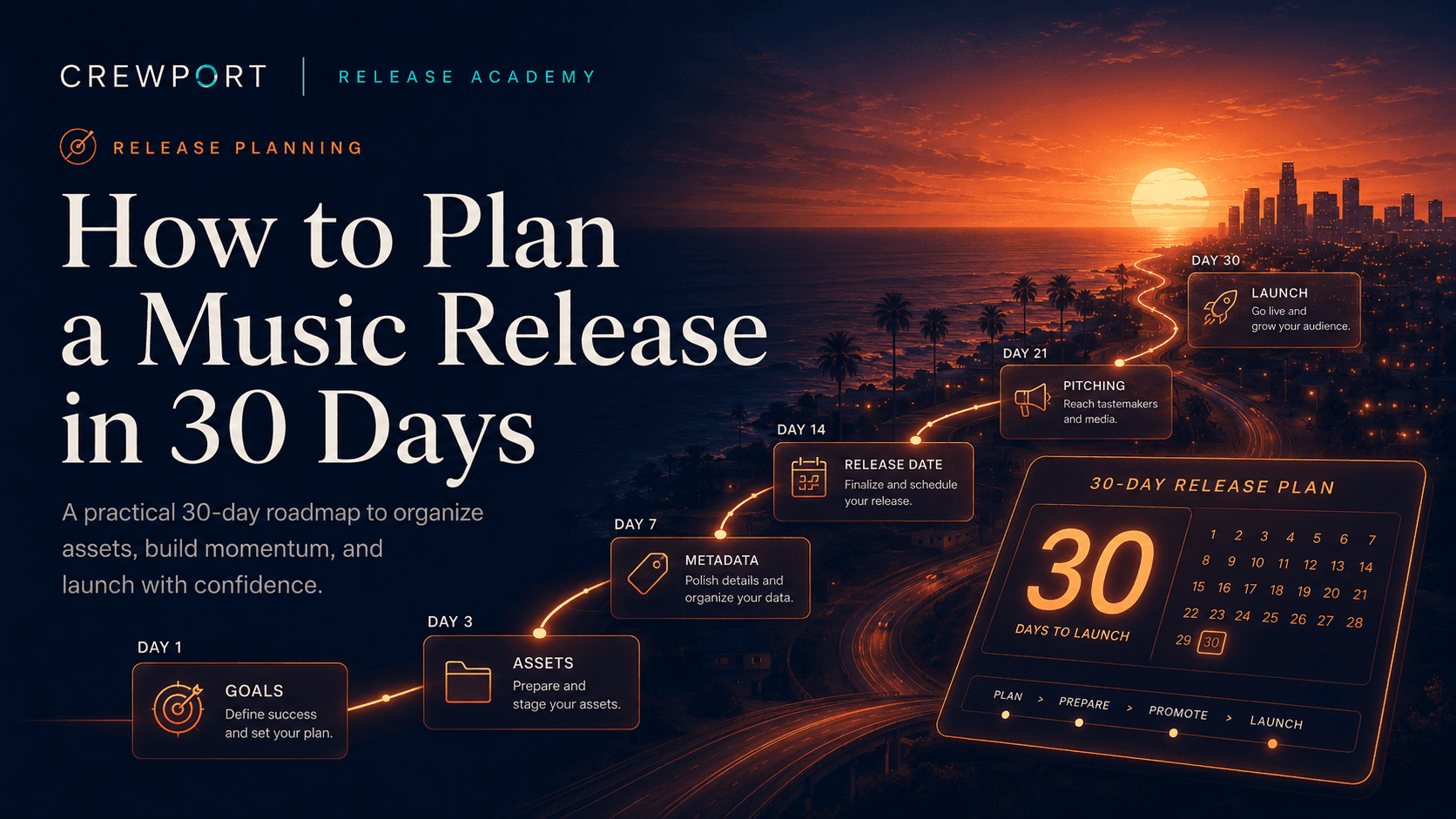
Thirty days is a tight window for a release. It's not impossible — but it requires
making clear decisions about what you can and can't do in the time available, and
executing without gaps.
The biggest mistake with a 30-day timeline is trying to run the same campaign you'd
run with eight weeks. You can't pitch Spotify editorial. You can't build a long pre-save
campaign. You have less time for press outreach and organic content buildup. Accepting
these constraints early — and planning around them instead of pretending they don't
exist — is what separates a release that lands from one that quietly underperforms.
Here's how to use 30 days well.
What you need before day one
Before the 30-day clock starts, three things must already be done:
- Finished master — approved, no further changes planned
- Finished cover art — 3000×3000px, RGB, no embedded URLs or handles
- Complete metadata — track title, artist names, credits, ISRC, UPC, genre,
rights confirmation
If any of these aren't ready, your 30-day timeline doesn't start yet. Starting the
clock before your assets are finalized is how releases get delayed.
Days 1–3: Submit and set up
Submit to distribution immediately.
With a 30-day window, you have no buffer for submission delays, metadata rejections,
or cover art issues. Submit on day one. If your distributor flags a problem, you want
to know on day two — not day ten.
What to do:
- Submit your release with your target release date set 25–28 days out
- Double-check every metadata field before submitting — fix it now, not after
- Note that the Spotify editorial pitch window requires 7 weeks minimum — with
30 days, that window is closed. Accept this and move on. - Set up your pre-save link as soon as your release is submitted and a Spotify
pre-save URL is available
Days 4–10: Build your foundation
With distribution submitted and a pre-save live, focus on three things this week:
Claim and update your artist profiles
If you haven't already, claim your Spotify for Artists and Apple Music for Artists
profiles. Update your artist bio, header image, and any profile links. A release
landing on an incomplete or outdated profile wastes the traffic it generates.
Build your smart link or landing page
Create a single link that will house all platform links on release day. This is what
goes in your bio, your posts, your email — one destination that works regardless
of which platform your audience uses.
Start content creation
You have roughly three weeks of pre-release content to create. Don't wait until
week three to start. Map out what you're going to post and when:
- Behind-the-scenes content from recording or production
- The story behind the track — what it's about, where it came from
- Short audio clips or visual teasers
- Pre-save call-to-action posts
Aim for consistent posting from day 7 onwards — not a burst at the end.
Days 11–20: Pre-save campaign and outreach
Pre-save campaign
Your pre-save link should be actively promoted throughout this period. Every post,
every story, every piece of content should be driving toward it. The goal is to build
a list of listeners who will generate day-one streams and saves when the track drops.
Be specific in your ask. "Pre-save my new track — link in bio" is weaker than
"Save it now so it goes straight to your library the moment it drops on Friday."
Tell people what the pre-save actually does.
Independent playlist outreach
Without Spotify editorial eligibility, independent playlist curators become more
important. Build a targeted list of playlists in your genre — not the biggest ones,
but the ones with engaged audiences and active curation.
Pitch them individually, not with a mass email. Include:
- A brief, direct description of the track — genre, mood, tempo, influence
- Your release date
- A private listening link — SoundCloud, private YouTube, or distributor preview
- Why you think it fits their playlist specifically
Send these 10–14 days before release so curators have time to review and add
before or shortly after the track goes live.
Press outreach
With 30 days, you're unlikely to land major editorial coverage — lead times at most
publications are 4–6 weeks minimum. Focus instead on smaller blogs, independent
music sites, and genre-specific communities where turnaround is faster.
Days 21–27: Final push
Confirm delivery
Before you shift into full release mode, confirm your release is delivered and
scheduled on every platform. Check Spotify, Apple Music, TikTok, and Instagram
specifically. Do not start your main promotional push until you've confirmed the
track will actually be live on release day.
Intensify content
The week before release is when content frequency increases. Move from 3–4 posts
per week to daily if your audience and platform support it. Build anticipation without
exhausting your audience before the track is out.
Prepare release day content in advance
Write the captions. Export the graphics. Schedule what can be scheduled. On release
day you want to be responding to your audience — not scrambling to post.
Day 28–30: Release week
Release day
- Confirm the track is live on every platform before you post anything
- Push your smart link across all channels simultaneously
- Notify your email list
- Post across all social platforms
- Respond to every comment and message — engagement signals matter in the
first 24–48 hours
Days after release
Do not go quiet. The algorithm is evaluating engagement for the next 10–14 days.
Keep posting. Share any playlist adds, press mentions, or listener reactions.
Post content that extends the conversation around the track — the story behind
a lyric, a live clip, a reaction to early listener feedback.
What a 30-day plan can't do
Be honest with yourself about the limitations:
- No Spotify editorial eligibility — the 7-week window is closed
- Limited press lead time — most major blogs and publications won't cover
a release with less than 3–4 weeks notice - Shorter pre-save buildup — less time to grow the pre-save list means fewer
day-one streams from that channel - Less time for content buildup — organic reach takes time to compound;
a shorter runway means less of it
None of these make a 30-day release impossible. They mean you need to be realistic
about outcomes and focused on the things you can actually execute well in the time
you have.
Common mistakes
- Submitting to distribution on day one of a 30-day plan with unfinished metadata
— this turns a 30-day plan into a 25-day plan - Trying to pitch Spotify editorial anyway and wasting time on an ineligible release
- Saving all content creation for the last week and posting in a panic
- Not confirming platform delivery before release day
- Going quiet immediately after release instead of sustaining activity through
the algorithmic evaluation window
CrewPort workflow tip
On a tight timeline, any delay in distribution is disproportionately costly. Submitting
with a metadata error that takes three days to resolve doesn't just cost three days —
it can cost your entire pre-save buildup window. CrewPort checks metadata before
submission so errors surface immediately, not after your distributor has already
flagged the release and sent it back.
FAQ
Can I realistically get on playlists with a 30-day timeline?
Independent curated playlists — yes, if you pitch early and pitch specifically.
Spotify algorithmic playlists — yes, through strong early engagement data, not
through direct pitching. Spotify editorial playlists — no, the window requires
7 weeks minimum.
Should I delay my release to get more time?
If you have flexibility, yes — a 60-day plan almost always produces better results
than a 30-day plan for the same release. But if the date is fixed for a reason,
a focused 30-day campaign executed well beats a poorly executed longer one.
How many pre-saves should I aim for in 30 days?
There's no universal benchmark — it depends on your audience size and engagement.
Focus on the percentage of your existing audience that converts, not the absolute
number. A 10% conversion from your active followers is a strong result.
Is it worth paying for promotion with a 30-day window?
Paid social promotion can accelerate pre-save growth and release day reach —
but only if the content it's promoting is good and the targeting is specific.
Broad paid promotion with a short window rarely generates meaningful returns.
What's the most important thing to get right with a 30-day release?
Metadata and submission — on day one, correctly, with no errors. Everything
else in the plan depends on the release actually going live on time.
Last updated: May 2026
Working with a tight release timeline? CrewPort is built to move fast without
cutting corners — metadata checks, delivery tracking, and pre-save tools in one place.
Apply for Early Access →