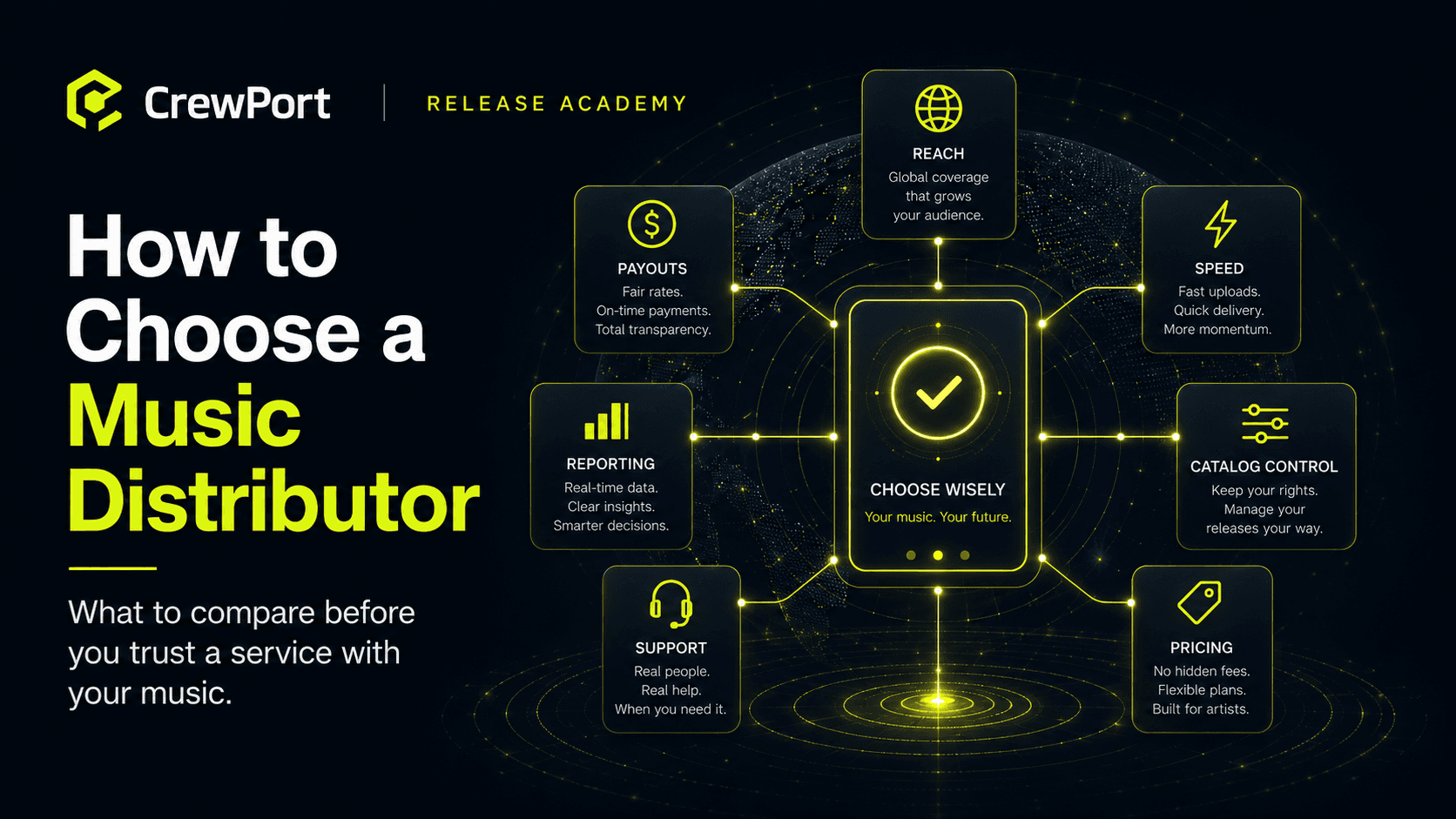
There are dozens of music distributors available to independent artists right now.
Most of them will get your music onto Spotify. The differences show up everywhere else —
in how they handle metadata errors, delivery failures, royalty reporting, and what happens
when something goes wrong.
Choosing a distributor based on price alone is one of the most common mistakes
independent artists make. Here's what to actually look at.
Start with what you need
Before comparing distributors, be clear about your situation:
- Are you releasing a single track or building a catalog over time?
- Are you releasing as an individual artist or managing multiple artists or a label?
- Do you need pre-save links, smart links, or playlist pitching tools built in?
- How important is transparent royalty reporting to you?
- Do you want to pay upfront per release, or share a percentage of your royalties?
Your answers change what matters most. A first-time artist releasing one single has
different needs than a producer managing fifteen releases a year across multiple artists.
What to look for in a distributor
Store reach
At minimum, your distributor should deliver to Spotify, Apple Music, Amazon Music,
YouTube Music, TikTok, and Instagram. Most major distributors cover these. Where they
differ is in smaller or regional platforms — Deezer, Tidal, Anghami, Boomplay, NetEase.
If you have a significant audience in a specific region, check whether that region's
dominant platform is in the store list.
Metadata handling
This is where most distributors quietly fail. Find out:
- Does the distributor check your metadata before submission, or does it pass errors
downstream to the platform? - Can you update metadata after submission without taking the release down?
- How are ISRC codes assigned and documented?
A distributor that catches metadata errors before submission saves you from release
delays, duplicate artist profiles, and royalty tracking failures. One that doesn't will
leave you finding out about problems after the release is already live.
Delivery transparency
Can you see, store by store, whether your release has actually been delivered and
is live? Or does the dashboard just show "submitted" and leave you to check manually?
The difference matters when you're actively promoting a release and need to know
it's actually available everywhere before you direct people to it.
Royalty reporting
Look for reports that break down earnings by platform, territory, and release. Vague
aggregate numbers — "you earned $47 this month" — make it impossible to understand
where your income comes from or catch discrepancies.
Ask: how long is the reporting lag between when streams happen and when you see
them in your dashboard? Industry standard is 1–3 months. Some distributors are faster.
Pricing model
The two main models are flat fee and revenue share.
- Flat fee — you pay per release or per year, keep 100% of royalties. Makes sense
if your music earns consistently or you release frequently. - Revenue share — low or no upfront cost, distributor takes 10–30% of earnings.
Makes sense early on when upfront cost matters more than the percentage.
Watch for hidden fees: some distributors charge extra for ISRC assignment, for
delivering to certain stores, for keeping older releases live, or for taking a release down.
Read the pricing page carefully before committing.
Contract terms
Key questions:
- Is there an exclusivity clause? Can you use multiple distributors for different releases?
- What happens to your catalog if you stop paying or cancel your account?
- How quickly can you take down a release if you need to?
- What are the payout minimums and schedules?
Some distributors hold your catalog hostage behind continued payments. Others have
takedown delays measured in weeks. These terms matter more than the monthly fee.
Support
When something goes wrong — a release rejected, a rights conflict, a missing royalty —
how do you reach someone? Email only? Ticket system with a 5-day response time?
Live support?
Test this before you commit. Send a pre-sales question and see how long it takes to
get a real answer.
What doesn't matter as much as you think
Brand recognition
The biggest names in distribution are not necessarily the best fit for independent
artists. Large distributors built for major labels operate at a scale where individual
artist support is minimal. Smaller, focused distributors often handle independent
releases better.
The number of platforms
Getting your music onto 150 platforms sounds impressive. In practice, the vast majority
of independent artist revenue comes from 5–7 platforms. A distributor that delivers
to 40 stores cleanly is more valuable than one that delivers to 150 stores inconsistently.
Promotional promises
Be skeptical of distributors that promise playlist placement, editorial consideration,
or "promotion" as part of a paid tier. Playlist placement is earned, not purchased.
A distributor's job is delivery — not promotion.
Red flags to watch for
- No clear information about contract terms or how to cancel
- Vague royalty reporting with no breakdown by platform or territory
- No metadata review before submission
- Unclear or delayed payout schedules
- No information about what happens to your catalog if you leave
Common mistakes
- Choosing a distributor based on which one a YouTuber recommended
- Not reading the contract before uploading a release
- Signing up for a revenue share model without calculating what that percentage
costs over time as your catalog grows - Switching distributors without exporting ISRC codes first
- Not testing support responsiveness before committing
CrewPort workflow tip
When evaluating any distributor, ask one specific question: what happens when my
release has a metadata error? The answer tells you almost everything about how the
platform is built. A distributor that catches errors before submission is built around
your release going well. One that passes errors downstream is built around processing
volume. CrewPort checks metadata before submission and shows you store-by-store
delivery status — because a release that's live everywhere, correctly, is the only
acceptable outcome.
FAQ
Can I use more than one distributor at the same time?
Yes, for different releases. Most distribution agreements are non-exclusive per release,
meaning you can use different distributors for different projects. You cannot distribute
the same release through two distributors simultaneously — that creates rights conflicts
on the platforms.
What happens to my music if I cancel my distributor account?
This depends entirely on the distributor's terms. Some remove your catalog from all
platforms immediately. Others give you a grace period. Some require a separate takedown
request per release. Read the cancellation terms before you sign up.
Should I choose a free distributor or a paid one?
Free usually means revenue share. Paid usually means flat fee with 100% royalties.
Neither is universally better — it depends on how much your music earns. If you're
earning consistently above a few hundred dollars per year, a flat fee model typically
works out cheaper over time.
How do I move my catalog from one distributor to another?
Export your ISRC codes from your current distributor first. Then submit your releases
through the new distributor using those same ISRCs. Coordinate the timing so the new
distribution is live before the old one is taken down — a gap in availability costs you
streaming history and playlist placements.
Do I need a separate distributor for each country?
No. Digital distributors deliver globally by default. Your release goes to every country
where the platform operates unless you specifically restrict territory.
Can a distributor help me get on editorial playlists?
Some distributors provide pitch submission tools that connect to Spotify for Artists
and Apple Music's official editorial submission systems. This is not the same as the
distributor getting you on a playlist — it's a tool that gives you access to the same
official channel every artist has. Actual editorial placement depends entirely on the
quality and positioning of your release.
Last updated: May 2026
Looking for a distributor built around getting your release right, not just getting
it uploaded?
Apply for Early Access →