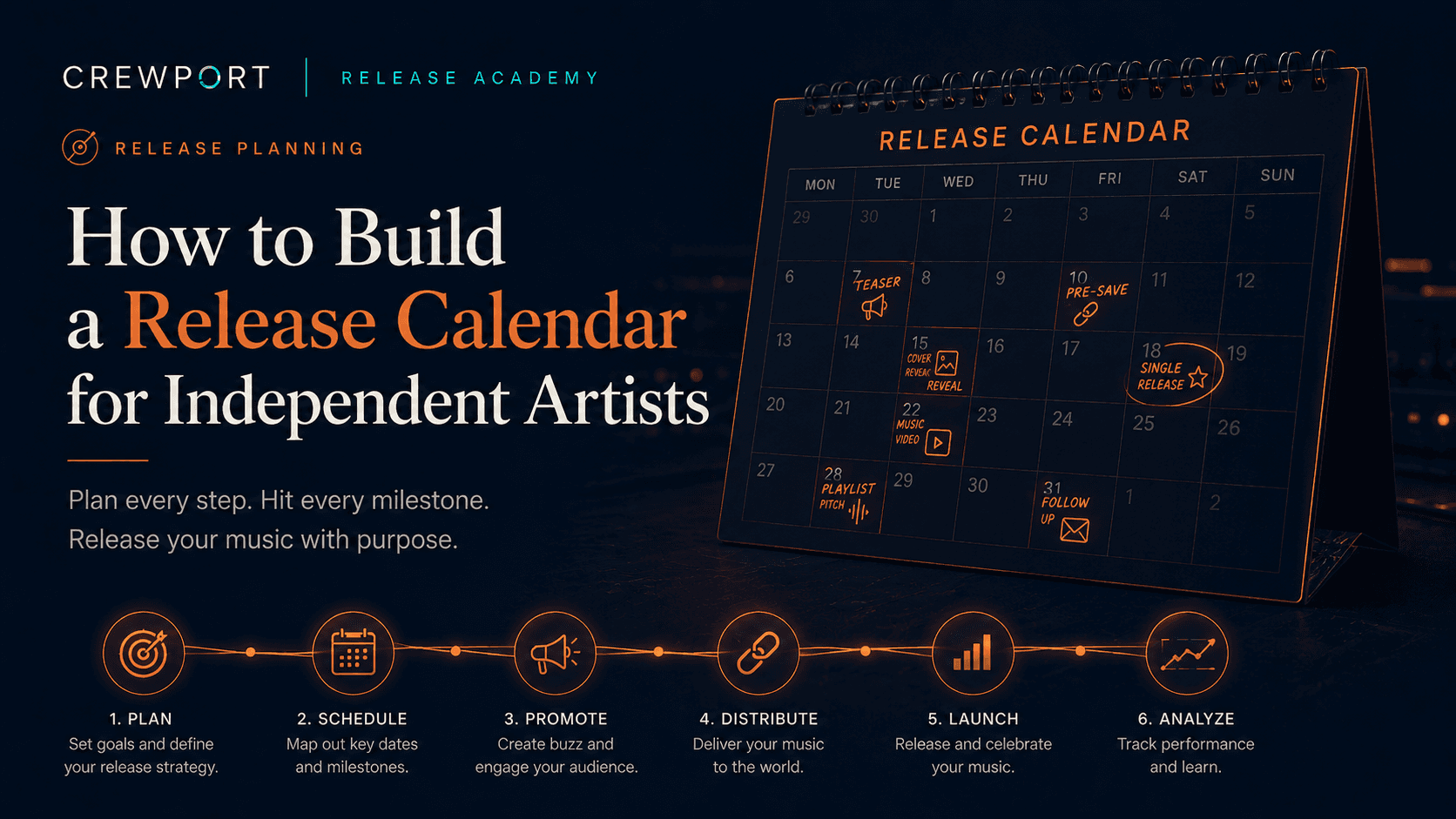
A release calendar is not a schedule of when to post on Instagram. It's a system
for managing your entire output as an artist — what you're releasing, when, in what
order, and how each release connects to the next.
Artists who release consistently and intentionally build catalog, audience, and
algorithmic momentum over time. Artists who release whenever something is finished
and then go quiet in between spend every release starting from zero.
The difference is almost never talent. It's planning.
Why a release calendar matters
Every release you put out has a lifecycle. It builds for a few weeks, peaks around
release day and the week after, then gradually settles into your back catalog where
it continues to generate streams passively.
When you plan releases in sequence, each new release reactivates your entire catalog.
A listener who discovers your new single in April goes back and streams everything
you put out before it. Algorithmic playlists like Spotify's Release Radar and artist
radio refresh when you release new music — pulling in listeners who may not have
found you otherwise.
Without a calendar, these effects happen accidentally, if at all. With one, you design
for them.
What a release calendar actually contains
A release calendar isn't just a list of release dates. It tracks:
- What you're releasing — single, EP, album, remix, or alternate version
- Release date — confirmed, not aspirational
- Distribution submission deadline — worked back from the release date
- Spotify editorial pitch deadline — 7 weeks before release date
- Pre-save setup date — when the link goes live
- Content campaign window — when pre-release promotion begins and ends
- Press outreach dates — first and second wave
- Post-release window — how long active promotion continues after release
Every release on the calendar should have all of these dates filled in before
you start working on it. If they're not filled in, it's not a calendar — it's a wishlist.
How to structure your release year
There's no universal formula for how often to release. The right cadence depends
on how fast you create, how much time you have for promotion, and what your
goals are. But there are some frameworks that work consistently for independent artists.
Singles-led strategy
Release a single every 4–8 weeks throughout the year. This keeps you consistently
visible in algorithms and audience feeds, builds catalog steadily, and maintains
momentum between larger projects.
Each single can stand alone or be grouped into an EP or album later — a practice
sometimes called "rolling release," where an album is assembled from singles
that have already been individually released and tested.
This strategy works particularly well if you create quickly and your audience
engages strongly with individual tracks.
Project-led strategy
Build toward an EP or album as the central event of a release cycle. Release one
or two singles in the months before the project drops to build audience and generate
editorial interest.
The singles serve double duty: they introduce the project to new listeners while
giving existing fans something while they wait. The album or EP then arrives
with an audience already primed for it.
This strategy works better for artists whose music is designed to be experienced
as a body of work, or who have longer creation cycles between projects.
Hybrid strategy
Most working independent artists operate somewhere between these two. A project
every 12–18 months, anchored by singles every 6–8 weeks — some of which feed
into the project, some of which stand alone.
Building the calendar in practice
Step 1: Inventory what you have
Before planning future releases, know what's already finished or nearly finished.
Sort your catalog into three groups:
- Ready to release — master complete, artwork done, metadata ready
- In production — recording or mixing in progress
- Concepts — ideas that aren't yet in production
Only release-ready material goes on the calendar with confirmed dates.
In-production material gets estimated completion windows. Concepts don't
get dates yet.
Step 2: Set your anchor dates
Choose two or three dates in the year that represent your most important releases —
a project launch, a significant single, a release timed to a specific season or event.
Build the rest of the calendar around these anchors.
Step 3: Fill in the gaps
Between anchor releases, identify windows for smaller singles or supplementary
content. Aim for a release gap of no less than 4–6 weeks between drops —
enough time to run a real campaign for each release without overlap.
Step 4: Work backwards from every date
For each release date, fill in every upstream deadline:
- Distribution submission: 7–8 weeks before release date
- Spotify editorial pitch: 7 weeks before release date
- Pre-save live: 3–4 weeks before release date
- First-wave press outreach: 5–6 weeks before release date
- Content campaign start: 4–6 weeks before release date
If working backwards from a release date produces a submission deadline that has
already passed, move the release date. Don't skip the submission window.
Step 5: Review for overlap
Check that no two active campaigns overlap significantly. Running a pre-save push
for one release while also in the peak promotion window for another splits your
audience's attention and dilutes both campaigns.
A minimum of 2–3 weeks of clear air between the end of one active campaign
and the start of the next pre-release window is a good rule of thumb.
Tools for managing a release calendar
You don't need specialized software. A spreadsheet or a simple project management
tool is enough. What matters is that the calendar is:
- Visible — somewhere you actually look at it regularly
- Editable — easy to update when dates shift
- Complete — every deadline filled in, not just release dates
A basic release calendar spreadsheet might include columns for:
- Release title
- Format (single / EP / album)
- Release date
- Submission deadline
- Editorial pitch deadline
- Pre-save launch date
- Campaign start date
- Campaign end date
- Notes
One row per release. One view of your entire year.
Adjusting the calendar when things shift
Releases move. Masters take longer than expected. Life happens. A release calendar
that can't flex isn't useful.
When a date shifts, update every downstream deadline immediately. A release date
that moves two weeks later doesn't just affect the release date — it affects the
submission deadline, the editorial pitch window, the pre-save timing, and the
content calendar. Update all of them at once.
The only deadline that genuinely can't shift without cost is the Spotify editorial
pitch window. Once that's missed, it's missed. Everything else is adjustable.
Common mistakes
- Setting release dates without working back to check if the submission deadline
is achievable - Releasing two projects too close together and splitting promotional energy
between them - Building a calendar for the first quarter of the year and abandoning it by March
- Not updating upstream deadlines when a release date moves
- Planning too many releases and executing none of them well
CrewPort workflow tip
Your release calendar and your distribution workflow should be connected, not
managed in separate places. When a release date is set in CrewPort, submission
deadlines and delivery tracking are tied to it — so you're not manually calculating
lead times in a spreadsheet while your release is being processed somewhere else.
FAQ
How often should an independent artist release music?
There's no universal answer, but a general guideline: often enough to stay visible
in algorithms and audience feeds, not so often that you can't run a real campaign
for each release. For most independent artists, one release every 4–8 weeks is
a sustainable and effective cadence.
Should I release music in summer or hold releases for autumn?
Both periods have trade-offs. Summer streaming volumes are high but editorial
attention is often lighter — fewer major campaigns competing, but also fewer
editorial push moments. Autumn, particularly September and October, is historically
strong for editorial consideration. Neither is universally better — what matters
more is your readiness and your campaign quality.
Is it better to release a single or an EP first?
For most independent artists building an audience, singles first. Singles are
easier to promote, easier for new listeners to engage with, and generate individual
stream counts that feed algorithmic playlists. An EP released before you have
an audience often underperforms relative to the effort that went into it.
How far in advance should I plan my release calendar?
A rolling 3–6 month view is practical for most independent artists. Beyond 6 months,
release dates tend to shift too much to plan in detail. Keep a longer-term vision —
the projects you're building toward over the next year — but lock in specific dates
and campaigns for the next quarter.
Can I release the same song on multiple dates across different platforms?
No — your release date should be the same across all platforms. Staggering release
dates by platform creates confusion for listeners and complicates promotional timing.
The only exception is a limited exclusive window on a single platform, which is a
specific marketing strategy rather than a default approach.
Last updated: May 2026
Want to manage your release calendar and distribution workflow in one place?
Apply for Early Access →