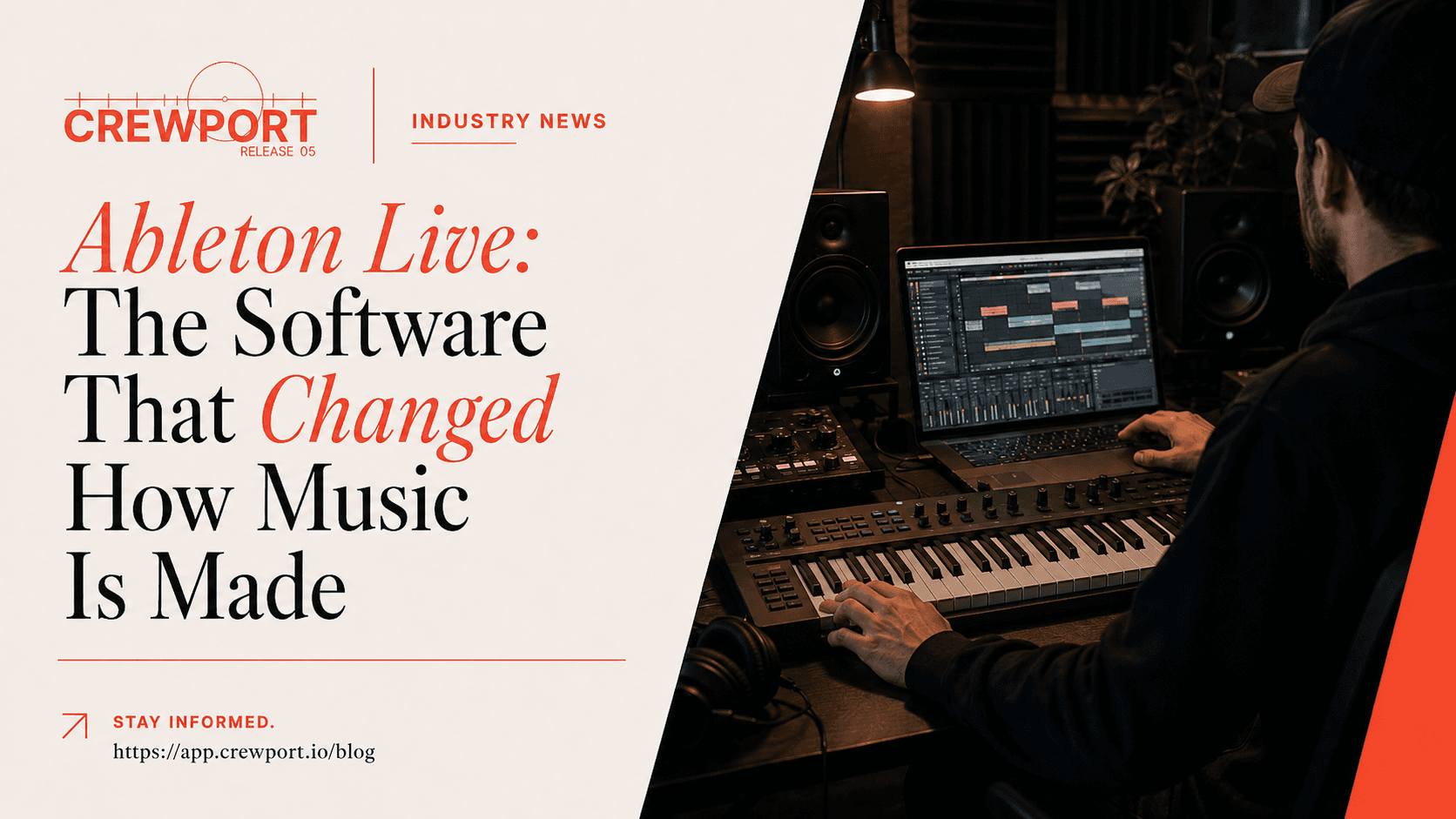
Ableton Live: The Software That Changed How Music Is Made
From a Berlin techno club to the laptops of the world's biggest producers — the story of the most influential DAW ever built
It Started in a Berlin Squat
The year is 1995. Berlin's electronic music scene is still raw, underground, and obsessed with experimentation. Two students at the Technische Universität Berlin — Gerhard Behles and Robert Henke — are performing minimal techno under the name Monolake. They have a problem: the software available to perform live on laptops is either too clunky, too rigid, or simply doesn't exist yet.
With no intention of expanding their software beyond personal use, the two tinkerers would often patch together homemade programs just to play specific pieces or shows. They were building tools for themselves — not for a market.
Existing production programs like Pro Tools and Logic were designed to record and edit sounds after musicians had already played them. Behles and Henke wanted to write music in real time on laptops as they grew more portable.
That frustration became the seed of Ableton.
The Third Man and the First Version
Bernd Roggendorf, a fellow computer programmer introduced through mutual friends, joined the pair at the tail end of the '90s, encouraging them to turn the jumbles of Max code they had holding together Monolake's live shows into a more generalized software for retail.
Ableton was officially founded in 1999 by Gerhard Behles, Robert Henke, and Bernd Roggendorf. Two years of development followed. Version 1 of Ableton Live was entirely focused on looping audio and samples, primarily with live performance in mind. "We decided to go for audio loops first because Gerhard had experience with time-stretching audio; he wrote his master thesis about it," Henke recalled.
On October 30, 2001, Ableton Live 1.0 shipped. It was unlike anything else on the market.
Hans Zimmer Was the First to Get It
At their very first trade show, Behles and Henke demoed the software to a stranger who seemed unusually intrigued. After the demo, he just said, "Do you have a card?" — and only then did they get to read his name tag. It was Hans Zimmer. Hans told them, "you have something interesting here," and they believed he was the first person who understood the software could work in a completely different area than what they were assuming.
The guy who would later score Inception, Interstellar, and Dune spotted Ableton's potential before the electronic music world did.
What Makes Ableton Different
Every DAW records music. Ableton does something else entirely — it lets you perform music.
The secret is two modes that no other software had at the time:
Session View — a grid-based interface where you trigger loops, samples, and clips in any order, in real time. Think of it as a live instrument rather than a recording system. You can improvise, layer, and rearrange on the fly without stopping the music.
Arrangement View — a traditional timeline, like every other DAW, where you build a finished track from left to right.
Live made it easier for musicians to use computers as instruments in live performance without programming their own software, influencing the rise of global festival culture in the 2000s.
That last part is huge. Before Ableton, performing electronic music live meant lugging crates of records or stacks of hardware. After Ableton, it meant opening a laptop.
The Timeline: How Live Grew Up
- 2001 — Live 1.0 launches. Audio loops only. No MIDI. No virtual instruments. But the Session View already exists.
- 2002–2003 — Versions 2 and 3 refine the formula without radical changes.
- 2004 — Live 4 was the biggest overhaul since the program's introduction, adding MIDI sequencing for the first time — meaning users could now work with virtual instruments and record and edit MIDI note information. This is when Ableton became a real DAW.
- 2010 — Ableton introduced Max for Live, enabling connectivity between Max and Live — effectively turning the software into an infinitely expandable creative platform. Producers could now build custom instruments and effects from scratch.
- 2013 — Ableton Push launches, a hardware controller designed to work seamlessly with Live, turning it into a fully tactile instrument.
- 2023 — Push 3 launches in two versions: tethered and fully standalone — meaning Live can now run without a computer at all.
- 2024 — Ableton releases Move, a compact portable groovebox with deep Live integration.
Who Uses Ableton
This is where the list gets serious.
Skrillex — relies on Ableton Live to create his genre-defining EDM and dubstep tracks, using its advanced warping capabilities to manipulate samples while maintaining quality, alongside FM8 and Massive for his aggressive basslines and intricate leads.
Deadmau5 — drawn to Ableton for its fast, intuitive workflow and deep sound design capabilities, he describes it as a fun, creative layout that makes experimenting with sounds effortless. The Max for Live integration is central to his process since sound design is at the core of his music.
Diplo — one of Ableton's most famous advocates. "I can teach Ableton to anybody in five minutes," he has said. He and Skrillex used Ableton to produce "Where Are Ü Now" with Justin Bieber — and the New York Times did an entire feature breaking down how they built the track inside the software.
Flume — the Australian producer uses Ableton as his primary DAW, and his intricate sound design and chopped vocal textures are a direct product of the software's clip-based workflow.
Burial — the influential UK producer uses Ableton Live's atmospheric capabilities for introspective and ethereal compositions that helped define the sound of UK dubstep and hauntology.
Hans Zimmer — yes, the film composer. Ableton Live is one of Zimmer's most powerful tools when it comes to both finishing a film score and adding special effects. He was, after all, the first person to recognize what the software could do.
Kenny Beats — the hip-hop producer famous for his YouTube series builds entire trap beats live on camera in Ableton, making it one of the most-watched demonstrations of the software's speed and workflow.
A Few Facts You Probably Didn't Know
- 🏫 Ableton gives away its software to schools. In 2016, the company began giving away its software for classroom use after Behles sat in on music courses and called it a "pivotal moment."
- 💰 Everyone wants to buy them — and they keep saying no. Music industry analyst Mark Mulligan of MIDiA Research has said: "If Ableton was to put itself into the market, there would be a feeding frenzy." Behles doesn't care.
- 🖥 The office is in Prenzlauer Berg, Berlin — the same neighborhood where the underground scene that inspired the software was born.
- 🎵 Robert Henke left Ableton in 2016 to focus entirely on his Monolake project — the same music project that started it all.
- 🎮 Push 3 Standalone runs Live internally with its own CPU, battery, and hard drive. No laptop required.
Why It Still Wins
After 25 years, Ableton Live remains the DAW of choice for electronic music producers, live performers, and sound designers worldwide — not because it's the most powerful on paper, but because it's the most playable. It treats music like a live instrument, not a document to be edited.
That idea — born in Berlin, built by two techno producers who just wanted to play a show — ended up changing how the entire world makes music.
All referenced facts are based on publicly available interviews, Wikipedia, and official Ableton communications.